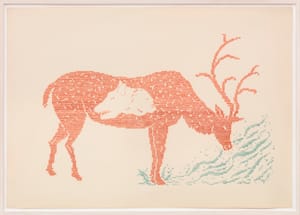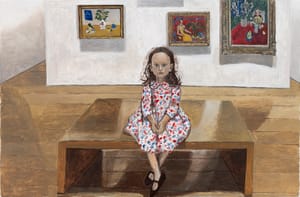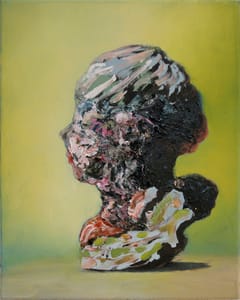
Monica De Cardenas is pleased to announce The Human Stain, an exhibition titled after Philip Roth’s celebrated novel. The group show brings together artists whose practices engage with the human figure and its zones of ambiguity, drawing out – through painting – memories, dreams, and emotions. The “stain” emerges as both a metaphorical and a material presence: on the one hand, it points to what remains suspended within the image, not fully articulable or legible; on the other, it resides in the very substance of painting itself, in brushwork and traces of color. Within this space, the figure appears unstable, oscillating between presence and dissolution, recognition and erasure.
Michael Ajerman (New York, 1977; lives in London) approaches painting as a means of probing emotional states and the perception of the present, allowing gesture and color to shift in response to the subjects and ideas at stake. His images unfold without premeditation, developing through free associations in which irony, ambiguity, and a subtle voyeuristic undertone coexist. In this process, painting asserts itself both as a vehicle for meaning and as a playful act, fully aware of its own materiality.
At the core of Emilio Gola’s practice (Milan, 1994; lives in Milan) is the depiction of everyday life within his generation. His paintings portray friends in informal situations – conversations, moments of waiting, rest, or domestic social scenes. Dense, layered compositions accumulate ordinary objects, creating images suspended between intimacy and unease. Through an intense and tactile figurative language, Gola explores human relationships, vulnerability, and interpersonal dynamics, transforming private experience into a shared narrative.
Although abstract, Erin Lawlor’s paintings (London, 1969; lives in London) reveal an underlying figurative substratum with organic resonances – currents of air and water, atmospheric elements, the passing of seasons. These are translated onto the surface as gestures and fields of force, evoking a sense of volatility and flux reminiscent of the perpetual movement found in certain eighteenth-century paintings.
Christopher Orr (Helensburgh, 1967; lives in London) produces works that hover between figurative suggestion and atmospheric dissolution, at the threshold of the natural and the supernatural, history and folklore, fiction and formalism. Drawing on nineteenth-century British painting and masters such as J.M.W. Turner, Orr transforms dreamlike visions into compositions in which light and atmosphere act as generative forces, suspending narrative and unsettling perception.
Alessandro Pessoli (Cervia, 1963; lives in Los Angeles) constructs his paintings through a fluid interplay of techniques and styles, where collage and spray paint merge with painterly gesture. His work weaves together references to art history, cinema, theatre, and popular culture in images poised between irony and the grotesque. Painting becomes a process of linguistic, symbolic, and physical construction and deconstruction, in which history is reimagined as a mutable space for exploring the subconscious and its tensions.
Gideon Rubin (Tel Aviv, 1973; lives in London) employs subtraction as a perceptual strategy, removing facial features to render his subjects as anonymous, archetypal presences. This neutralization produces a tension between recognition and distance, evoking both familiarity and mystery, and opening a space for projection and memory.
Ivan Seal (Stockport, UK, 1973; lives in Berlin) develops a vocabulary of forms and objects that appear to emerge from an internal logic, detached from observable reality. His compositions construct an ambiguous plausibility, where seemingly recognizable elements become unstable and elusive. The resulting images function as simulacra, suspended between mental projection and material presence.
Guy Yanai (Haifa, 1977; lives in Marseille) builds his images through a precise and distilled pictorial language, defined by flat surfaces, shallow spatial depth, and carefully calibrated chromatic relationships. Landscapes, interiors, and everyday objects – filtered through memory and mediated imagery – are reduced to essential structures and rigorous compositions. His work is grounded in a process of reduction, where each element is meticulously measured. Within this formal economy, what is omitted introduces a latent dimension that subtly alters perception and generates a quiet, underlying tension.